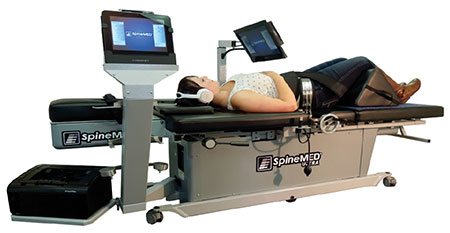
Spinal decompression is a non-surgical therapy that gently stretches the spine to reduce pressure on compressed discs and the nerves around them. The stretch creates negative pressure inside the disc, which encourages bulging or herniated material to retract and eases the nerve irritation causing your pain. Treatment is drug-free, requires no recovery time, and is performed while you lie fully clothed on a specialized table.
The reason it works comes down to a quirk of anatomy. Spinal discs have almost no direct blood supply of their own. They depend on pressure changes as you move to draw in fluid and nutrients, rather like a sponge. When a disc is compressed and you have spent years mostly sitting, that exchange slows down, the disc loses height and hydration, and it becomes both less able to cushion and less able to repair itself.
Decompression interrupts that cycle. By creating controlled negative pressure, it does two things at once: it reduces the mechanical pressure on the nerve, which addresses your pain now, and it improves the flow of fluid and nutrients into the disc, which supports the disc’s own repair over the course of treatment.
We use the SpineMed® Decompression System, which is FDA-cleared and treats both the lower back and the neck. It is worth distinguishing this from ordinary traction. Traction pulls. Decompression uses a computer-controlled cycle that varies the force, which prevents the muscles from guarding against the stretch. That guarding response is exactly what limited older traction methods, and avoiding it is why decompression reaches the disc rather than fighting the muscles around it.
Conditions Spinal Decompression Can Help
Decompression is specifically suited to problems where something is pressing on a disc or a nerve. It is not a general-purpose treatment for every kind of back pain, and part of your evaluation is determining whether your particular problem is one it can actually address.
It is commonly used for:
Herniated and bulging discs, in the lower back or the neck, where disc material presses outward against nearby nerves.
Sciatica, where compression in the lumbar spine sends pain, numbness, or tingling down through the buttock and leg.
Degenerative disc disease, where discs have lost height and hydration over time and no longer cushion effectively.
Spinal stenosis, a narrowing of the spinal canal that reduces the space available to the nerves.
Facet joint syndrome, irritation of the small joints at the back of the spine that guide its movement.
Numbness and tingling in the arms or legs caused by nerve compression rather than peripheral nerve damage.
If your symptoms turn out to stem from something decompression cannot help, we will tell you and point you toward what will. For a fuller picture of the conditions themselves, see our page on back, neck, and sciatica pain.
What a Course of Treatment Looks Like
1. Evaluation and candidacy.
Not everyone is a candidate, and that determination comes first. We take your history, examine your movement and nerve function, and review imaging or order it where needed. Certain conditions, including some fractures, advanced osteoporosis, spinal hardware from prior surgery, and pregnancy, may make decompression inappropriate, which is exactly why we screen before we treat.
2. Your report of findings.
You get a clear explanation of what is compressed, whether decompression is likely to help, how many sessions the protocol involves, and what it will cost. Insurance benefits are verified at no charge beforehand.
3. Your sessions.
You lie fully clothed on the SpineMed® table and are comfortably secured with a harness system. The table applies a gentle, cycling stretch to the target area for roughly 20 to 30 minutes. Most patients find it relaxing, and a fair number fall asleep. There is no recovery period, and you drive yourself home and go about your day.
4. Supporting care between sessions.
Decompression works considerably better in combination than alone. Chiropractic care with Dr. Lina Yousofi, D.C., addresses the alignment and joint restriction around the treated segment. Where inflammation is limiting progress, Dr. Joseph Sclafani, M.D., QME, or Megan O’Connor, MSN, FNP-BC, may add physician-administered injections. Rehabilitation rebuilds the support that protects your result.
5. Reassessment.
We compare your findings against your baseline through the course of treatment rather than relying on how you feel on a given day. Nerve symptoms typically improve in a pattern, receding up the limb toward the spine, and that pattern often shows up before the pain fully subsides.
6. Protecting the result.
The habits that compressed the disc are still waiting for you when treatment ends. Exercise, posture and ergonomic guidance, and in some cases bracing or custom orthotics are what keep you from repeating the process.
Why We Do Not Offer Decompression on Its Own
Some clinics sell spinal decompression as a standalone package. We do not, and the reasoning is straightforward.
Decompression is genuinely good at one thing: taking pressure off a disc and the nerve near it. It is not designed to correct the alignment problem that loaded the disc unevenly for years, or to calm the inflammation surrounding an irritated nerve root, or to rebuild the deep muscular support that failed somewhere along the way. Treat only the compression and you have addressed the most painful part of the problem while leaving the machinery that produced it fully intact.
That is why our decompression patients are also receiving chiropractic care, why some are receiving physician-administered injections, and why all of them get rehabilitation. Each element does something the others cannot. The combination is what makes results hold up after the sessions end.
It also reflects how this practice is built. Dr. Sclafani is double board-certified in Pain Medicine and Physical Medicine & Rehabilitation and completed a clinical spine fellowship. Dr. Yousofi has practiced chiropractic since 1998. Having both in one office means a decompression plan can be adjusted in real time based on how you are responding, rather than proceeding through a fixed package regardless.
Spinal Decompression in Tracy and San Joaquin County
Non-surgical spinal decompression is not available on every corner, and for a long time the nearest options for patients in this part of the valley meant a drive to the Bay Area or Sacramento. Having the SpineMed® system here in Tracy removes a barrier that mattered more than it might sound.
The reason is the protocol. Decompression is delivered as a series of sessions over several weeks, not a single visit. A course of treatment that requires crossing the Altamont in traffic is a course of treatment most people abandon partway through, and partial completion is the most common reason patients conclude that decompression “did not work” for them. Ten minutes from home is what makes finishing realistic.
We treat patients from Mountain House, Lathrop, Manteca, Stockton, Lodi, and Ripon. Our office is at 227 East 11th Street, on 11th by Tracy High School, across from McDonald’s, sharing a parking lot with Center Appliances, with parking right outside.
We are at 227 East 11th Street in Tracy, on 11th Street by Tracy High School, across from McDonald’s, sharing a parking lot with Center Appliances. Our hours are Monday through Thursday, 9am to 6pm.
Some patients feel improvement within the first week or two, while others need several weeks before the change is clear. Nerve symptoms often improve before pain does, and in a recognizable pattern, receding up the limb toward the spine. Your provider will point out these markers so you can track real progress rather than guessing day to day.
Yes. The SpineMed® system treats the cervical spine using a specialized configuration that positions the neck precisely and controls the angle and degree of stretch. Cervical decompression is used for neck pain, disc problems in the neck, and the numbness and tingling that can travel into the arms and hands.
Coverage varies significantly by plan. We offer complimentary insurance verification, so call (209) 830-1799 and we will determine exactly what your plan covers before you commit. Financing through CareCredit, Cherry, and United Credit is available as well.
It can produce lasting relief, and for many patients it does. What determines whether it holds is largely what happens afterward. If the mechanics, posture, and daily loading that produced the herniation go unaddressed, the same forces are still at work. That is the reason we pair decompression with chiropractic care and rehabilitation rather than offering it on its own.
Yes. There is no recovery time, no sedation, and no restriction on driving. Patients routinely come in on a lunch break and return to work. Many schedule sessions before or after a shift.
Decompression is not appropriate for everyone. Certain fractures, advanced osteoporosis, some spinal hardware from previous surgery, certain tumors, and pregnancy are among the reasons someone may not be a candidate. This is precisely why we evaluate and review imaging before treating rather than after.
No, and the difference matters. Traction applies a steady pull, which triggers your muscles to guard against it and limits how much actually reaches the disc. The SpineMed® system uses a computer-controlled cycling force that prevents that guarding response, which is what allows the treatment to create genuine negative pressure inside the disc.
A session runs roughly 20 to 30 minutes. A course of treatment is a series of sessions over several weeks rather than a handful of visits, because the disc changes we are aiming for happen gradually. You will get a specific number in your report of findings, with reassessment built in.
No. Most patients describe a gentle, rhythmic pulling sensation, and many find it relaxing enough to doze off during the session. You remain fully clothed and lie comfortably on the table while the system does the work. Some people feel mild soreness after their first session or two as the spine adapts, similar to the feeling after a good stretch.
Your Health, Our Priority
Stop Living Around Your Joint Pain
Schedule a consultation and let our team build a plan to get you moving freely again — naturally.