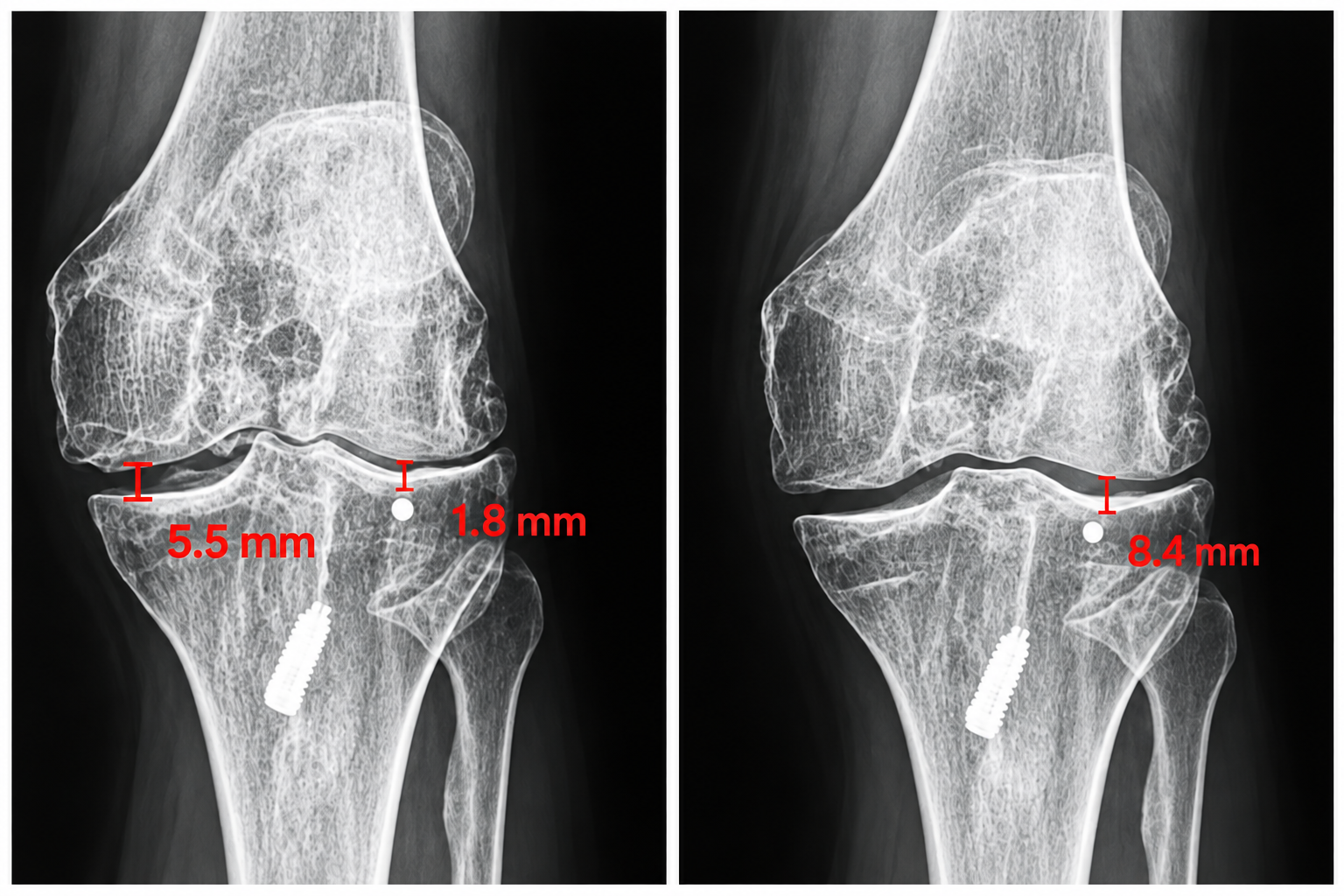
Knee Before And After Treatment
Real x-ray images from one of our recent successful patients. Image on the left was taken before treatment, image on the right was taken 1 year post treatment.
What Causes Knee and Joint Pain?
Knee and joint pain is discomfort, swelling, or stiffness where two bones meet, most often caused by cartilage gradually wearing down, an old injury that never fully healed, or years of repetitive strain. It usually builds slowly rather than arriving all at once, and it responds best to care that addresses the damage inside the joint instead of only quieting the symptoms.
The knee takes the worst of it for most people. Cartilage is the smooth cushion that lets the joint glide, and once it thins, the bones begin to make contact in ways they were never built to. That contact produces the familiar pattern: an ache after you have been on your feet, stiffness in the morning that takes a while to work out, swelling by the end of a long day, and eventually a knee that you simply do not trust on stairs.
The same wear-and-tear process affects the hip, shoulder, elbow, and ankle. What differs is how each joint tells you about it. A hip often speaks up as groin pain or trouble putting on shoes. A shoulder announces itself when you reach overhead or roll onto it at night. An elbow flares with grip and rotation. They share an underlying cause, which is why they also share a treatment approach.
Here is the part worth holding onto. Joint pain being progressive does not mean it is untreatable. Cartilage loss cannot be undone, but the inflammation, instability, and muscle compensation stacked on top of it are very much treatable, and for a great many patients that is where most of the day-to-day pain actually lives.
Signs It Is Time to Have Your Joint Looked At
Most people wait longer than they should. Joint pain has a way of normalizing itself, and you adapt without noticing: you stop taking the stairs, you start sleeping on one side, you quietly drop the things you used to enjoy. By the time it feels urgent, you have often been compensating for years.
You do not need to be in severe pain to be worth evaluating. It is worth having your joint looked at if you recognize any of the following:
- Pain that has outlasted a few weeks of rest. Something that has not resolved on its own is unlikely to resolve on its own.
- Stiffness in the morning, or after you have been sitting a while, that takes several minutes of moving around to loosen up.
- Swelling or warmth around the joint after ordinary activity, which points to inflammation rather than simple soreness.
- Grinding, clicking, or catching, or a knee that feels as though it might buckle when you shift your weight onto it.
- Changes you have made without deciding to, like avoiding stairs, shortening walks, or favoring one leg.
- A recommendation for joint replacement that you would rather explore alternatives to first.
That last one brings a lot of people through our door. Being told you need a replacement is not the same as being out of options, and it is a reasonable moment to get a second opinion from a team whose entire approach is non-surgical.
Joint pain is a symptom rather than a diagnosis, so the first job is always identifying what is actually driving yours. Our evaluation sorts out whether you are dealing with cartilage loss, a soft tissue injury, inflammation, instability, or some combination, because those call for meaningfully different plans.
Conditions we regularly treat at our Tracy office include:
- Knee osteoarthritis, the gradual cartilage breakdown behind most chronic knee pain, including cases where a replacement has already been suggested.
- Meniscus tears and cartilage damage, including the instability that makes a knee feel like it may give out underneath you.
- Hip osteoarthritis and labral injuries, which often show up as groin pain or difficulty with bending, sitting, and dressing.
- Shoulder injuries including rotator cuff and labrum tears, supraspinatus involvement, and the shoulder blade pain that travels with them.
- Elbow, wrist, and hand pain such as tennis elbow, golfer’s elbow, tendonitis, and carpal tunnel syndrome.
- Sacroiliac osteoarthritis, where the joints connecting your spine to your pelvis create deep, aching low back and buttock pain.
If your particular joint is not on that list, it is still worth a call. The underlying approach applies broadly, and a short conversation will tell us quickly whether we are the right fit for you.
How We Treat Knee and Joint Pain
Our care is built and delivered by a team rather than a single provider, which means the plan can draw on medical, chiropractic, and rehabilitative treatment at the same time instead of one at a time.
1. A thorough evaluation and report of findings.
We start by listening to your history, examining the joint, and reviewing imaging or ordering it where needed. You then get a clear report of findings: what is actually happening in that joint, what is realistic to expect, and what your plan will involve. Nothing begins before you understand it.
2. Regenerative therapy and PRP injections.
Administered by Dr. Joseph Sclafani, M.D., QME, or Megan O’Connor, MSN, FNP-BC, platelet-rich plasma concentrates the growth factors already in your own blood and delivers them directly to the damaged tissue. The goal is to stimulate repair at the source of the pain rather than mask the signal it is sending.
3. Prolozone® therapy.
Also physician-administered, prolozone combines medical-grade ozone with targeted nutrients. Ligaments and connective tissue have famously poor blood supply, which is exactly why they heal so slowly. Prolozone works by improving circulation into those structures so the body can do repair work it otherwise struggles to reach.
4. Chiropractic care and physiotherapy.
Dr. Lina Yousofi, D.C., addresses the alignment and movement problems that surround an injured joint. A painful knee changes how you walk, that change loads your hip and low back differently, and the compensation becomes its own problem. Corrective exercise rebuilds the strength and stability that protect your progress.
5. Bracing and custom orthotics.
When cartilage or meniscus loss is significant, an unloader brace reduces force through the damaged compartment while still allowing you to walk. That matters, because the gentle cyclic loading of ordinary walking is part of how healing tissue organizes itself. Custom orthotics address the same problem from the ground up.
6. Reassessment and long-term maintenance.
We measure progress against where you started, adjust the plan, and give you what you need to hold your gains. The objective is not simply a comfortable month. It is a joint that keeps working.
“After my knee treatment I’m back on my feet and active again — I can’t believe the difference 12 months later.” — Monica M., Knee Pain Patient
What to Expect at Your First Visit
Your first appointment runs about 45 minutes to an hour. Most of it is conversation and examination, because a good plan depends on understanding your history, not just your imaging. You will meet your provider, we will examine the joint, and if X-rays are useful we can take them here.
You will leave with a clear report of findings and a written plan, including what the care involves, roughly how long it should take, and what it will cost. We verify your insurance benefits at no charge before anything begins, and we will walk you through financing through CareCredit, Cherry, or United Credit if that is helpful. You will never be asked to commit to treatment you do not understand.
To make the visit go smoothly, please bring:
- Your driver’s license or photo ID, and your insurance card if you have one
- A list of your current medications and supplements, including dosages
- Any recent X-rays, MRI reports, or records related to the joint
- A brief history of prior injuries, surgeries, or injections in that area
If you have a family member who helps you make health decisions, they are welcome to come along. Many of our patients find it useful to have a second set of ears in the room.