
You Might Also Need
Related Treatments
Frequently Asked Questions
Frequently Asked Questions
We are at 227 East 11th Street in Tracy, on 11th Street by Tracy High School, across from McDonald’s, sharing a parking lot with Center Appliances. Our hours are Monday through Thursday, 9am to 6pm.
Yes, and a number of our patients do exactly that. Your provider will coordinate the timing so that treatments do not overlap in a way that complicates recovery from either.
No. PRP microneedling is a cosmetic treatment, so insurance does not cover it. Financing is available through CareCredit, Cherry, and United Credit if that is helpful, and we will review the full cost with you at your consultation before you commit to anything.
Not right away. Your provider will tell you how long to wait, typically at least 24 hours, so the micro-channels can close. Applying makeup too soon risks irritation and infection. Plan for a day of bare skin.
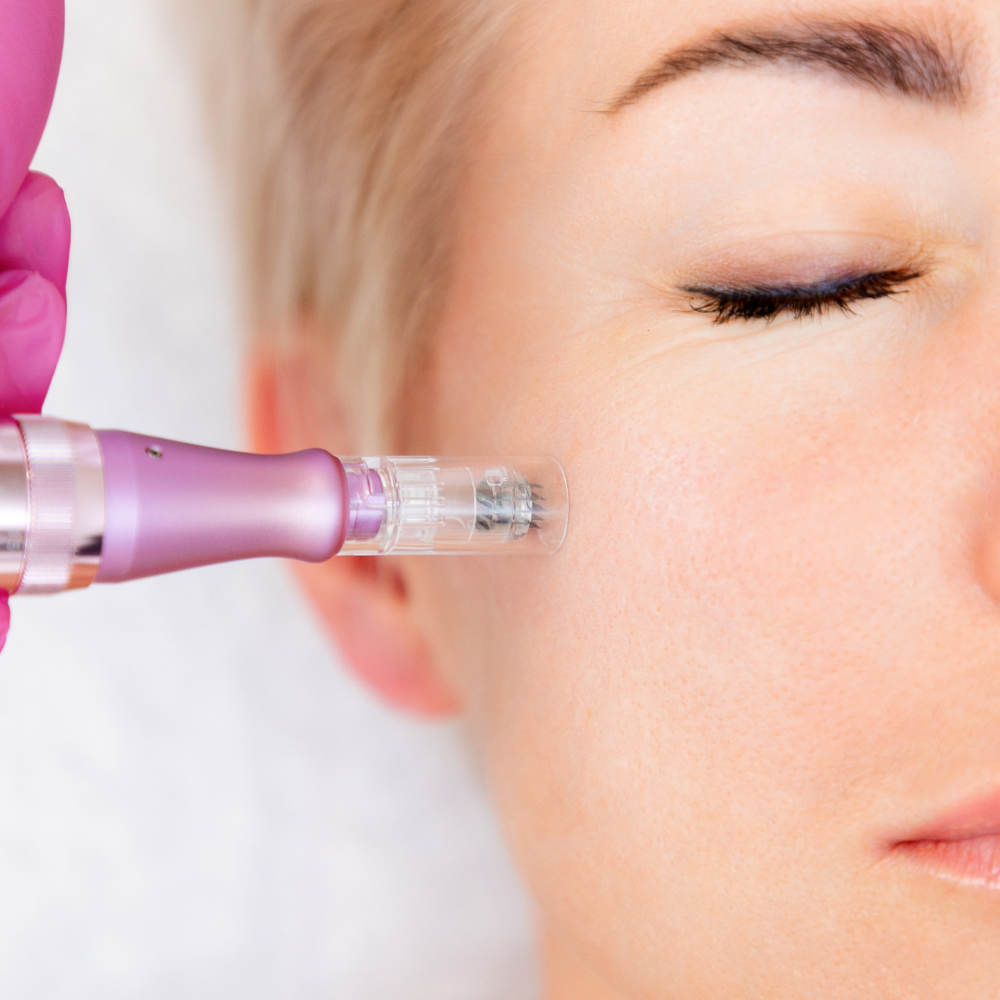
Microneedling alone works, and it produces good results by prompting your skin to repair itself. Adding PRP delivers concentrated growth factors from your own blood deep into the micro-channels, reaching the layer where collagen is produced. The channels are what give PRP a route in, which is why the combination outperforms either one applied on its own.
It has a good safety profile. Because the PRP is derived from your own blood, allergic reaction and rejection are not concerns. Microneedling is minimally invasive with a well-established record. It is not right for everyone, though: active skin infections, certain skin conditions, some medications including blood thinners and recent isotretinoin, and pregnancy are among the reasons we may recommend waiting or against treatment. We review your history at the consultation.
Some patients notice improved glow and texture within a week or two, but the meaningful change comes from new collagen, which the body produces gradually. Expect results to build over several weeks and to continue improving for a few months after a series. This is not an overnight treatment, and anyone telling you otherwise is overselling it.
Most patients get their best results from a series of sessions spaced several weeks apart, with the number depending on your skin and what you are trying to address. Acne scarring generally takes more sessions than overall rejuvenation. Your provider will recommend a specific plan at your consultation.
A topical numbing agent is applied beforehand, and most patients find the treatment tolerable, often describing the sensation as light sandpaper across the skin. Some areas are more sensitive than others, particularly around the forehead and along the jawline. Tell your provider if you are uncomfortable at any point.
Most patients have redness and a warm, tight feeling similar to a mild sunburn for one to two days, sometimes with light swelling. Most people feel comfortable in public within two to three days. Many schedule treatment before a weekend for that reason. You will get specific aftercare guidance, and sun protection matters more than usual while your skin recovers.