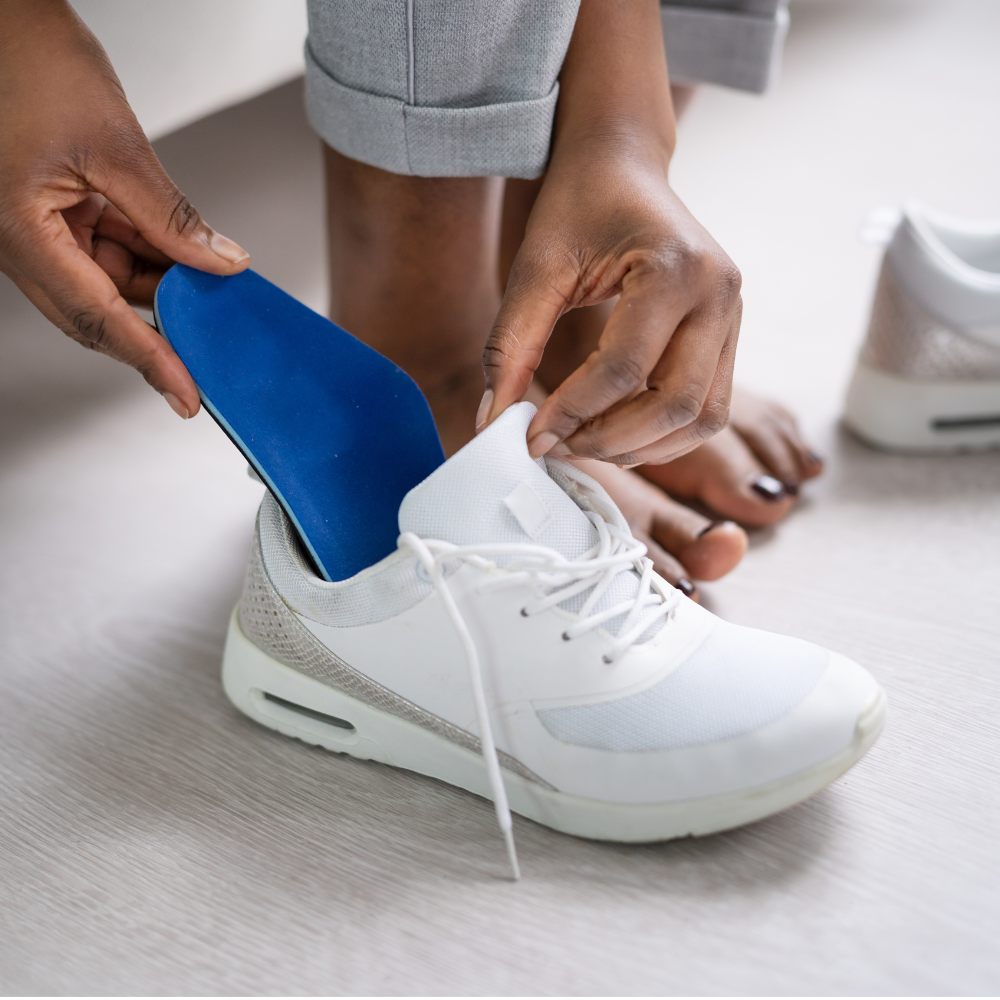
Why Support and Alignment Matter
Bracing and custom orthotics address a part of the problem that treatment alone cannot reach: the forces acting on your body every time you take a step. A brace reduces load on a damaged structure so it can heal while you stay active, and custom orthotics correct foot mechanics that send problems upward into the knees, hips, and lower back.
Your feet are the foundation of everything above them. Each step sends force up through the ankle, knee, hip, and spine, and how your foot meets the ground determines how that force is distributed. When a foot rolls inward excessively, which is called pronation, or when an arch is too high to absorb shock properly, the compensation travels up what is often described as the kinetic chain. Knee pain that will not resolve, a hip that aches on one side, low back pain with no obvious spinal cause: a meaningful number of these trace back to the feet.
Bracing works on a related principle from the other direction. A joint with significant cartilage or meniscus damage is being loaded through a compartment that can no longer handle it. An unloader brace shifts that force away from the damaged area while still allowing you to walk, which matters more than it sounds. Complete rest is not actually good for healing joint tissue. The gentle, cyclic loading of ordinary walking is part of how cartilage and meniscus cells organize and repair themselves. The goal is not to eliminate load but to redirect it.
This is why bracing and orthotics appear so often inside our treatment plans rather than as an afterthought. You can perform an excellent regenerative injection into a knee and then send the patient back out to load that same compartment ten thousand times a day. The support is what protects the work.
We fit and provide several types of support, matched to what your evaluation shows rather than sold from a shelf.
- Custom foot orthotics, made from a 3D digital scan of your foot in a weight-bearing position, so they reflect how your foot actually behaves under load rather than at rest.
- Unloader knee braces, which shift force away from a damaged compartment of the knee, particularly valuable where there is meniscus damage or significant cartilage loss.
- LSO back braces, lumbosacral orthoses that provide structural support to the lower spine during recovery from acute low back pain.
- General knee and joint bracing for stability during recovery from injury or while healing tissue rebuilds strength.
We work with Foot Levelers for custom orthotics, whose 3D digital scanning captures an accurate weight-bearing impression of the foot. That distinction matters: an impression taken while you are sitting does not reflect what your foot does when your body weight is on it, which is the entire situation the orthotic exists to address.
Custom Orthotics Versus What You Can Buy at the Drugstore
This is the question we get most, and it deserves a straight answer rather than a sales pitch.
Over-the-counter inserts are not useless. They provide cushioning, and for mild, general foot fatigue that is sometimes enough. If a twenty dollar insert solves your problem, we are glad, and we will tell you so.
What they cannot do is correct anything specific to you. A mass-produced insert is built to an average foot shape in a size range. It does not know that your left arch collapses more than your right, that your gait has adapted around an old ankle injury, or that your knee pain comes from how your foot pronates during push-off. Custom orthotics are built from a scan of your actual feet and prescribed based on an examination of how you move.
The evidence here is reasonable rather than overwhelming, and we would rather characterize it accurately. A frequently cited randomized controlled trial, “Shoe Orthotics for the Treatment of Chronic Low Back Pain,” found that custom orthotics, particularly when combined with chiropractic care, reduced low back pain and improved function. Some researchers argue the field needs more independent study, which is a fair criticism. What we can say from practice is that for patients whose pain has a clear mechanical component originating at the foot, orthotics frequently make a difference that other treatment alone did not.
The research on lumbar bracing is similarly practical. One study found that roughly 61 percent of patients using an LSO back brace for subacute low back pain took no pain medication during recovery, compared with about 40 percent of those without one. For a patient trying to get through a recovery without relying on medication, that is a meaningful difference.
Conditions That Benefit From Orthotic Support
Orthotics are prescribed for problems in the foot itself and, just as often, for problems further up the chain that originate there.
- Plantar fasciitis and heel spurs, where supporting the arch and cushioning the heel reduces strain on the plantar fascia.
- Flat feet and high arches, both of which change how force is distributed and how well the foot absorbs shock.
- Knee, hip, and low back pain with a mechanical origin in the feet, which is more common than most patients expect.
- Bunions and hammertoes, where improved alignment and reduced pressure may keep deformities from worsening.
- Athletic performance and injury prevention, improving stability and shock absorption for runners and court sports.
If you have been treated for one of these repeatedly without lasting improvement, the feet are worth examining. A recurring problem that keeps returning after treatment usually means the cause has not been addressed.
How Fitting Works At Birch Pain & Spine Group
Bracing and orthotics are prescribed after an examination, not chosen from a catalog. Dr. Lina Yousofi, D.C., assesses your gait, posture, and alignment, along with the joint or region causing you trouble, and looks at how your feet are contributing.
For custom orthotics, we capture a 3D digital scan of your feet in a weight-bearing stance, which is used to manufacture orthotics built to your specific structure. For bracing, we determine the right type and fit for your condition, which for knee bracing means identifying which compartment needs unloading.
Support is almost always part of a broader plan rather than the whole of it. Orthotics correct the mechanics while chiropractic care addresses the alignment problems those mechanics created. A knee brace protects the joint while regenerative therapy works on the tissue. Nothing here is sold as a standalone fix, because on its own it rarely is one.
Our office is at 227 East 11th Street in Tracy, on 11th by Tracy High School, across from McDonald’s, and we see patients from Mountain House, Lathrop, Manteca, Stockton, Lodi, and Ripon. Given how much of the work around here involves full shifts on concrete, in warehouses, in the fields, and in the trades, foot mechanics are a bigger factor in this community’s back and knee pain than most people would guess.